
Breaking Points: the report our industry needed and didn't want
Written By Wez - Reviewed by Paul Craddock (Founder) and Austen Gidley-Smith (COO). Published 09/09/2026
Forestry and arboriculture have spent twenty years getting better at physical safety. A new sector-wide report says we've been far slower to look after the people doing the work.
Tree work has changed enormously since the early 2000s. Harnesses, chippers, LOLER inspections, AFAG guidance, method statements, toolbox talks: the physical side of the job is measured, audited and improved every year. The part nobody measured was what the work does to people’s heads.
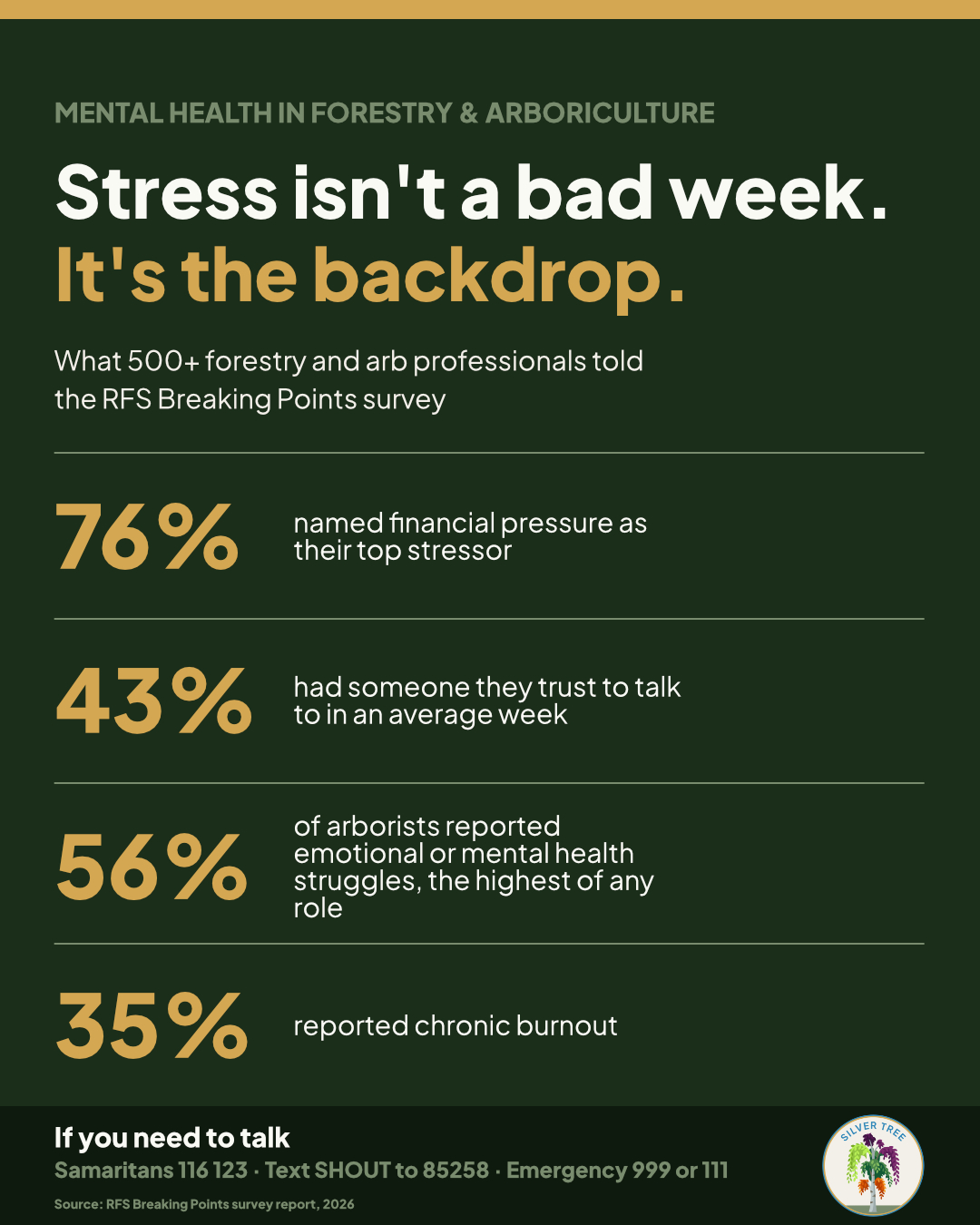
That has now been measured. The Royal Forestry Society, working with a coalition that includes Confor, the Forestry Commission, the Forestry Contracting Association, FISA and the Institute of Chartered Foresters, published the Breaking Points survey report earlier this year. More than 500 people across forestry and arboriculture took part: contractors, arborists, machine operators, manual workers and forest managers. The report describes stress in the sector as a constant backdrop rather than an occasional bad week.
What it found
The headline numbers are hard to read past.
- 76% of everyone surveyed put financial pressure at the top of their list of stressors.
- Only 43% had regular weekly access to someone they trust to talk to.
- 44% reported outright mental health struggles, and 35% reported chronic burnout.
- Among self-employed workers, 94% reported financial stress and 63% struggled with isolation.
- Among arborists specifically, 92% named safety risk as a primary stressor and 56% reported emotional or mental health struggles, the highest of any role group in the survey.
The report also sets out why this matters so much in our sector rather than in general. Suicide rates in the UK have risen over the last fifteen years, and men in middle age are at heightened risk. Forestry and arboriculture employ a lot of men in exactly that age bracket, and then add rural isolation, lone working, unstable income and genuine physical danger on top.
The cycle nobody escapes on their own
The most useful part of the report, for anyone running a team, is the finding that this stress is self-reinforcing. Financial pressure pushes people into longer days and tighter programmes. Long days and tight programmes produce fatigue. Fatigue produces poorer decisions on site, which is the last thing you want fifteen metres up with a running saw. Incidents and near misses then cost time and money, which increases the financial pressure again.
A culture where nobody wants to be the one who says they’re struggling keeps the whole loop running quietly. That is the bit the industry can actually change.
The part the public can help with
One finding will be familiar to anyone who has worked a roadside job. Tree workers regularly face hostility from members of the public who see a chainsaw and assume the worst. The RFS has produced an animation, Branching Out, addressing exactly this.
Almost every job we do has a reason behind it that isn’t visible from the pavement: a failed root plate, ash dieback, a deadwood limb over a school path, a thinning that gives the remaining trees room to mature, a crown reduction that keeps a veteran tree standing for another thirty years. We are usually working to a written specification, often signed off by a council tree officer or an ecologist.
So if you see a team working near you and it looks wrong, ask them. Most crews are pleased to explain it. Being shouted at from a car window on a wet Tuesday helps nobody, least of all the tree.
What we're doing about it at Silver Tree
We are not going to pretend we have this solved. What we can do is take the report’s findings seriously in the way we run jobs.
- Programme the work honestly. Quoting a job with realistic hours in it costs more than quoting it tight. It also means the crew isn't racing the daylight to make the numbers work.
- Pay on time. Financial pressure is the single biggest stressor in the survey, and for subcontractors and self-employed climbers, late payment is a large part of it.
- Make it a toolbox talk subject. Not just kit, PPE and cutting plans. Workload, fatigue and how people are actually doing belong in the same conversation.
- Check in on lone and remote working. Isolation showed up hard in the survey for self-employed workers and machine operators. A call at the end of the day is not a big investment.
- Back the crew on public abuse. If someone gets verbal on site, we want to hear about it, record it and deal with it. Nobody should be expected to simply absorb it as part of the job.
- Keep the support numbers visible. In our Reflow knowledge base and on the website.
If you're struggling
You do not need to be in crisis to talk to someone. If you’d rather not speak to anyone you work with, these are free, confidential and used by people in our industry every week.
- Samaritans, any time, call 116 123
- Shout, text SHOUT to 85258
- Mind, 0300 102 1234, Monday to Friday
- ANDYSMANCLUB, free peer support groups for men, every Monday 7pm, no booking or referral. andysmanclub.co.uk, contact form, info@andysmanclub.co.uk, 01422 362744
- CALM, 0800 58 58 58 or webchat, 5pm to midnight every day, free, confidential and anonymous, and open to anyone whatever their gender
- The DPJ Foundation, mental health support for rural and land-based work
- Stay Alive app, free suicide prevention resource
- NHS 111, call 111 and select the mental health option, free, 24/7, for urgent mental health support short of an emergency
- In an emergency, call 999
The RFS has published the full Breaking Points report, the Branching Out animation and a wider set of support links on its Mental Health and Wellbeing in Forestry hub. It is worth twenty minutes of anyone’s time, whether you run a company, manage an estate or climb for a living.
Read the RFS resources: rfs.org.uk/insights-publications/mental-health