
How to create shade in a south-facing garden
Written By Wez - 23/09/2026
A south-facing garden is the one everyone wants, right up until the patio is too hot to sit on by midday in July. This is how to get some shade back, why the sun’s path decides what works, and why autumn is the time to start.
The best way to shade a south-facing garden is to combine the two types of shade. A structure over the seating area, such as a pergola, awning or shade sail, gives cover straight away. Deciduous trees and climbers then give cooler, living shade that lets the sun back in over winter. Put overhead cover where you sit at midday, and a screen or planting on the west side for the low evening sun.
Most shade advice stops at a list of products. The more useful question is where the sun actually comes from at the times you want to be outside, because that decides whether you need a roof, a wall, a tree, or all three.
Start with the sun's path, not the shop
In a south-facing garden the sun crosses from east to west in front of the house, and its height changes a lot through the year. That gives you two different shade problems:
- High midday sun. In Gloucestershire the midsummer sun is about 60 degrees above the horizon at midday. It lands almost straight down on the patio, so only something overhead will block it: a pergola roof, a sail, an awning or a tree canopy.
- Low evening sun. On a summer evening the sun drops into the west and north-west, low and straight into your eyes. Overhead cover does almost nothing about it. What works is something vertical on the west side: a screen, a trellis panel with a climber on it, a pleached tree or a hedge.
Winter is the other half of the picture. At midday in December the sun is only about 15 degrees up, and that low light is exactly what makes a south-facing garden and the rooms behind it worth having. Anything that blocks it all year round costs you in winter. That is the argument for deciduous trees and climbers, which shade you in summer and drop their leaves just as you want the light back.
So spend ten minutes before choosing anything. Sit where you actually sit at the times you actually use the garden, and note where the sun is. Most people find they need overhead cover in one spot and a side screen in another, not one large structure over everything.
Midday sun needs cover overhead. Evening sun needs a screen on the west side.
Structures: shade straight away
A structure gives you shade the day it goes up, which is why most gardens need at least one even if the long-term plan is trees.
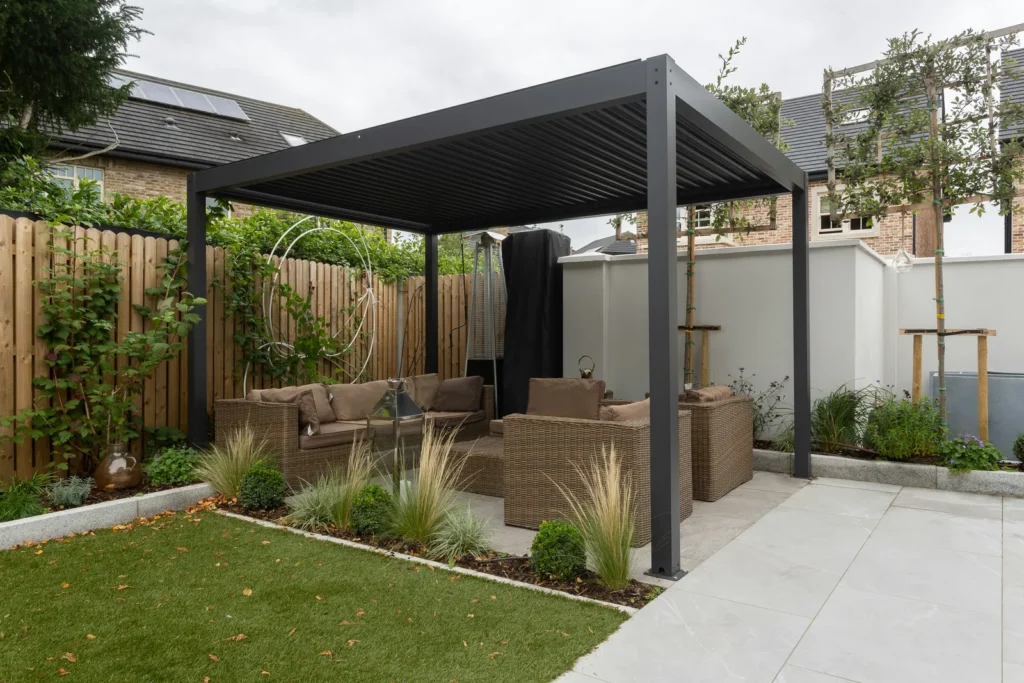
- Pergolas. A permanent timber or metal frame over the patio. The frame on its own gives only light shade, so the real value is what you put on top: slatted roof battens, a fabric canopy, or a climber trained over it. Build it strong enough for the climber you want. A mature wisteria is extremely heavy, and a flimsy kit pergola will not take it.
- Awnings. These fix to the house wall and retract when you don't need them. They are the best option where the patio is right up against the house, and they also keep the sun off the glass, so the room behind stays cooler. Check the wall can take the fixings, and choose one with a wind sensor or get into the habit of winding it in.
- Shade sails. The cheapest way to cover a large area, and they suit modern gardens. The fabric is the easy part. The anchor points take a lot of load in wind, so they need proper posts in concrete or solid fixings into masonry, not a fascia board or a fence post. Breathable knitted fabric lets hot air escape and runs cooler underneath than a waterproof sheet. Take sails down for winter storms.
- Parasols. The most flexible option. A cantilever parasol keeps the pole out of the way of the table and tilts to follow the sun, which makes it useful for evening sun too. It needs a heavy base, and it has to come down in wind.
Planning: most freestanding garden pergolas fall under permitted development, provided they stay under 2.5m high within 2m of a boundary. Listed buildings and conservation areas have tighter rules, and there are plenty of both around Cheltenham and the Cotswolds, so if either applies, check with the council before building.
Trees and climbers: shade that cools
Shade from leaves feels cooler than shade from a sheet of fabric. That isn’t your imagination: leaves release water as they transpire, which cools the air around them, and they don’t soak up heat and radiate it back the way a canopy or a wall does. The catch is time. A tree takes a few years to give useful shade, which is why the best plan is usually a structure now and planting behind it.
For most gardens the right tree is smaller and lighter than people expect. The job is dappled shade over a seat, not a dark canopy over the whole lawn.
| Tree | Shade it gives | Typical garden height |
|---|---|---|
| Amelanchier (snowy mespilus) | Light, dappled. Spring blossom and good autumn colour. | 5 to 8m |
| Multi-stem birch | Light, airy. Best for a soft screen rather than deep shade. | 8 to 12m |
| Field maple | Medium to dense. Native, tough, happy on chalk and clay, takes pruning well. | 8 to 12m |
| Crab apple | Medium. Blossom, fruit for birds, stays compact. | 4 to 7m |
| Pleached hornbeam or lime | A raised green screen on clear stems. Ideal on the west boundary for evening sun and privacy. | Kept at about 3.5 to 4m |
| Japanese maple | Light, and too small to shade a seat in most cases. Plant it for looks, not shade. | 2 to 5m |
Before planting, think about distance from the house. A lot of lowland Gloucestershire sits on clay, which shrinks and swells as tree roots take up water. As a rough rule, keep a tree at least as far from the house as its expected mature height, and further for thirsty species such as willow, poplar and oak. If a mature tree is already there and casting too much shade, the answer is often crown thinning or lifting rather than removal, which lets light through while keeping the tree.
Climbers are the fastest living shade, and the best way to finish a pergola:
- Hops die back each winter and regrow several metres every summer, so you get a full canopy fast and bare timber in winter.
- Grape vines give a proper leafy roof over a few seasons, and a south-facing garden is the right place for them.
- Virginia creeper and Boston ivy are excellent for cooling a hot south or west wall, with strong autumn colour. They climb on their own, so keep them trimmed back from gutters and windows.
- Wisteria and honeysuckle bring scent and dappled shade. Wisteria is slow to settle and very heavy when mature, so it needs a solid frame.
Take the heat out of the garden
Some of the heat in a south-facing garden has nothing to do with shade. It comes from surfaces that soak up sun all day and give it back all evening.
- Break up large hard areas. A big run of dark paving or gravel can stay warm well after sunset. Swapping part of it for lawn, planting or a bed next to the seating makes a noticeable difference.
- Go lighter with new paving. Pale sandstone and light porcelain stay cooler underfoot than dark slate or charcoal paving. Worth knowing if you're relaying anyway.
- Let the furniture move. Lightweight furniture that follows the shade round the day often beats one fixed seating area in full sun.
- Screen the fence, not the sky. A trellis panel with a climber, or a slatted screen on the west fence, blocks low evening sun without building anything over your head.
What to plant in the new shade
Once you have shade, the planting under it needs to change. The mistake is treating all shade the same. Shade under a pergola or on the north side of a wall usually stays reasonably moist. Shade under a tree is often dry as well, because the tree takes the water and the canopy keeps the rain off. Plant for the kind you have.
Damp or partial shade
- Hostas (keep an eye out for slugs)
- Heucheras
- Hydrangeas
- Ferns, including the hardy shield ferns
- Foxgloves
- Fatsia japonica
Dry shade under trees
- Geranium macrorrhizum
- Wood spurge (Euphorbia amygdaloides robbiae)
- Great wood-rush (Luzula sylvatica)
- Epimediums
- Brunnera
- Butcher's broom and Sarcococca, for evergreen structure
A word on camellias, which appear on nearly every shade list. They need acid soil. Much of Gloucestershire, and almost all of the Cotswolds, is limestone and alkaline, where camellias go yellow and sulk. If you want one, grow it in a large pot of ericaceous compost and water it with rainwater.
Why autumn is the time to start
Most people start thinking about shade in a July heatwave, which is the worst time to plant anything. From late September through to March, the soil is still warm and moist and trees are going dormant, so new trees, hedging and climbers can settle their roots over winter without needing much watering. Bare-root trees and hedging are also cheaper and only available in this window.
Plant this autumn and a climber will be covering a pergola by next summer, and a young tree will have a full growing season behind it. Get a structure up over the winter too, and next summer is sorted.
Our landscaping team builds pergolas, patios and planting schemes across Gloucestershire, and our tree surgeons can thin or lift an existing tree if you have too much shade rather than too little. If you’d like someone to look at your garden and tell you what would actually work, ask for a free quote or call 01242 472560.
Frequently Asked Questions About Shade in south-facing gardens
What is the quickest way to shade a south-facing patio?
A cantilever parasol or a shade sail gives you shade the same week. An awning is the quickest permanent option where the patio is against the house. Trees and climbers take one to several seasons, so most gardens use a structure first and plant around it.
Is a pergola or a shade sail better?
A pergola is permanent, adds structure to the garden and can carry climbers, but it gives little shade on its own until you add a roof or planting. A shade sail is cheaper and gives full cover straight away, but it needs strong anchor points and should come down in winter storms. Many gardens use a pergola with a climber for the long term and a sail or parasol while the climber grows.
Do I need planning permission for a pergola?
Usually not. Most freestanding garden pergolas count as permitted development if they stay under 2.5m high within 2m of a boundary. Rules are stricter for listed buildings and in conservation areas, so check with your local council if either applies.
Which trees give shade without blocking winter light?
Deciduous trees shade you in summer and let the sun through in winter. For most gardens, amelanchier, crab apple, multi-stem birch and field maple are good sizes. Pleached hornbeam or lime makes a raised screen on a boundary without taking up much ground.
When is the best time to plant trees and climbers for shade?
Late September to March. The soil is still warm and moist and the plants are dormant, so roots establish over winter with little watering. Bare-root trees and hedging are only sold in this window and cost less than pot-grown ones.
Ready When You Are
Get next summer's shade
sorted this autumn.
Pergolas, patios, planting and tree work across Gloucestershire. We’ll look at where the sun actually falls and tell you what will work.
Or call · 01242 472560